

 Trust the Mojo
 Pattern

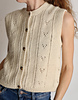
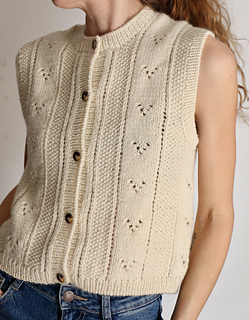
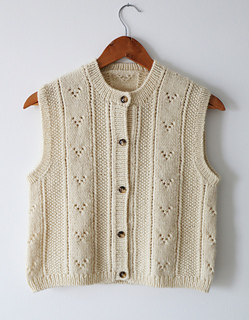
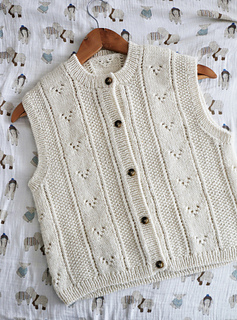
sencha vest


Language English
Construction
The Sencha Vest is worked from the top down, in flat knitting, with no seams. You begin by knitting the back with 4 mm needles, working back and forth, and making increases at the beginning and end of each row to shape the shoulders. The back is worked until the bottom of the armholes, then the stitches are placed on hold while you work the front pieces. Next, stitches are picked up along the back yoke’s increase rows. The right shoulder and front are knitted first, followed by the left shoulder and front, incorporating increases for the neckline. Once the shoulders and front pieces are complete, the left shoulder, back, and right shoulder are joined to knit the lower body. The lower body is finished with a 1x1 rib using 4 mm needles and the Italian bind-off. The armhole edges are knitted in the round with 3.5 mm needles in 1x1 rib and finished with the Italian bind-off. The button bands are also worked in 1x1 rib with 3.5 mm needles, using the Italian bind-off.
Level and content
The Sencha Vest is accessible, but some experience with reading charts is recommended. Unlike most Trust the Mojo patterns, which are written out in detailed instructions, this pattern is primarily chart-based. You will be guided through each step with written notes, but you’ll need to follow the charts to work the eyelet pattern correctly.
Shape and sizes
Sizes XS (S) M (L) XL (2XL) 3XL are suited for an approximate bust circumference of 80/85 (85/90) 90/95 (95/105) 105/112 (112/120) 120/130 cm, with a little ease. Be sure to take your own measurements to select the size that suits your desired fit. Try on the garment as you knit to adjust it to your body shape and preferences. For an adjusted fit, you can choose a size with negative ease.
Techniques
Cast on - knit & purl - increases - decreases - yarn overs - pick up stitches - slip stitches - Italian bind off - buttonholes
You will need
• 300/350 (350) 400 (500) 500/550 (600) 650 g of Sandness Garn « Peer Gynt » - 50 g/91 m
• 4 mm circular needles with a cable of 80 cm or more
• 3.5 mm circular needles with a cable of 40 cm or more
• 5 or 6 buttons 15 mm• Removable stitch markers
• 1 tapestry needle, scissors, pins and a flat surface to block your knitting
Sample
20 stitches x 30 rows = 10 x 10 cm, with 4 mm needles


 Ravelry download


 Cancel
28866 projects
stashed 16621 times
 stashed